In 1995, Nelson Rivera, director and curator of the Casa Roig Museum in Humacao, organized an exhibition of temporary installations that sought to transform a domestic space by turning the private family sphere into an artistic and public one, working from the physical setting itself rather than its representation. Awilda took over the dining room: she intervened in the floor, walls, and residual spaces, and used the table and chairs as supports for objects including money, soldiers, tanks, airplanes and kites, with military designs suspended from the ceiling. Everything suggested a war zone. The work, titled El colmo de lo obvio, made a direct reference to the US Navy training base in Vieques, transforming the family dining room into a site for discussing US military presence in Puerto Rico, the Caribbean, and beyond. The reference proved prescient: the movement to expel the Navy from the island would begin the following year. The work’s tone was unmistakably one of protest.
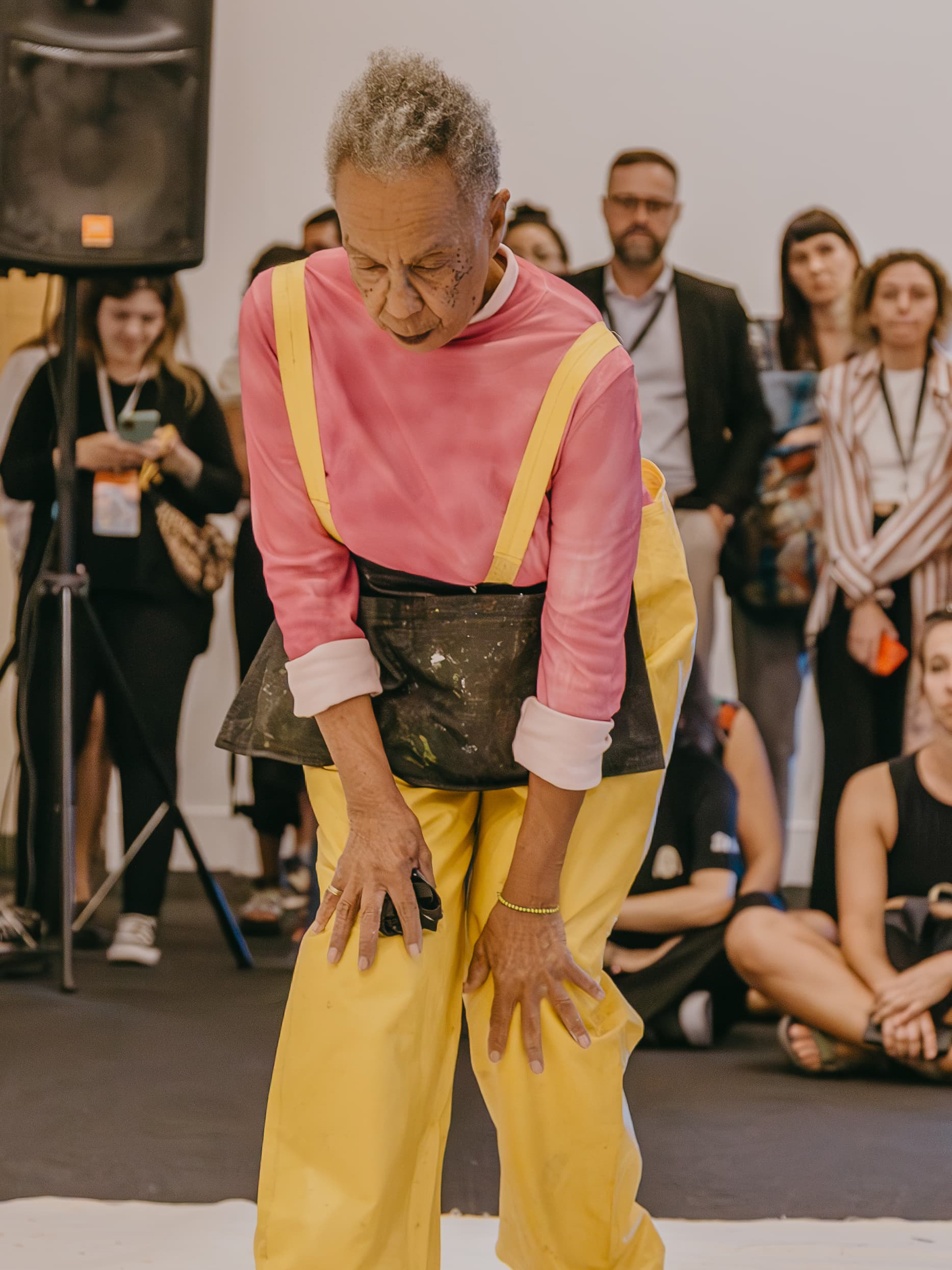
The series Estética del Desorden: Macandal is the most recent chapter in Awilda Sterling-Duprey’s practice, centered on transformation as a vital, political, and poetic act. The artist draws on the historical figure of François Macandal — rebel, mystic, and symbol of Afro-descendant resistance in Haiti — as a starting point for a deeply embodied painting process. Sterling-Duprey approaches Macandal as a paradigm of transformation. Through body, gesture, and abstraction, she evokes an insurgent presence inhabiting the Caribbean’s contemporary colonial condition. “I am the reincarnation of an enslaved soul,” she says, distilling the aim of the series: to embody the living memory of those who resisted and to connect with an imagined ancestry. Macandal becomes a bridge between the Haitian Revolution and Puerto Rico’s colonial reality. As viewers register the historical and emotional weight embedded in the works, they also participate in preserving and reactivating a collective memory through a silent dialogue that turns contemplation into an active gesture.
Credits
Estética del Desorden VIII (2025) [Aesthetic of Disorder VIII] El colmo de lo obvio (1996) [The Height of the Obvious] #1 (El colmo de lo obvio) (1996) [#1 (The Height of the Obvious)]
Acrylic, pastel, and oil on protective canvas; mixed media on canvas; mixed media on cotton.
Awilda Sterling-Duprey
Artist 1947, Puerto Rico; based in San Juan
Experimental, independent, and multidisciplinary artist living and working in San Juan, Puerto Rico. Her work explores identity, gender, diaspora, language, and migration, challenging conventional notions of cultural, national, and gender boundaries. Sterling-Duprey interweaves the marginalities of self-representation and resistance, confronting the silencing and invisibility of Afro-Caribbean women. Drawing from a multidisciplinary practice and Yoruba-Caribbean traditions, she transgresses the limits between drawing, painting, and performance through a decolonial approach that questions and redefines Puerto Rican artistic traditions.
She is a founding member of Pisotón, Puerto Rico’s first experimental dance collective. Her recent group exhibitions include Puerto Rico Negrx, curated by Marina Reyes Franco and María Elena Ortíz (Museo de Arte Contemporáneo, San Juan); no existe un mundo poshuracán: Puerto Rican Art in the Wake of Hurricane Maria, curated by Marcela Guerrero (Whitney Museum of American Art); Quiet as It’s Kept (The Whitney Biennial, Whitney Museum of American Art); Cimarronas: Black and Afro-descendant Women Artists (Museo Casa Escuté, Carolina, Puerto Rico); and Untitled II (Kilómetro 0.2, San Juan).